
Why We Watch Long-Term Interest Rates More Closely Than the Fed
Long-term interest rates tell you more about the economy than any Federal Reserve announcement. The Fed controls one rate, the overnight rate banks charge each other, and that rate is set by committee. The 10-year and 30-year Treasury yields are set by millions of buyers and sellers pricing what they think inflation, growth, and credit risk will look like years from now. That makes the long end of the curve a live poll of the economy rather than a policy statement about it.
At Freedom Capital Advisors, a Florida-registered investment adviser, we treat long-term rates as one of the primary inputs in how we position portfolios. Here is the clearest recent example. On September 17, 2025, the day before the Fed began cutting, the 10-year Treasury yielded 4.06% and the 30-year yielded 4.66%. The Fed then cut three times, lowering its target range by 0.75%. As of August 7, 2026, the 10-year yields 4.65% and the 30-year yields 5.19%. The Fed eased. The long end tightened anyway.
That gap is the whole point. Understanding why it happens changes how you read risk in a portfolio and helps you cut through the noise.
The Fed Sets the Floor, the Bond Market Sets the Price
The federal funds rate is an overnight rate. It governs what banks pay for money for one night. Almost nothing in the real economy is priced on an overnight basis. Corporate bonds, mortgages, commercial real estate loans, and capital expenditure budgets are priced off intermediate and long-term rates.
When the Fed cuts, short rates fall by construction. Long rates only fall if bond buyers agree that inflation and growth justify accepting less yield for a decade or more. If buyers disagree, they demand a higher yield to lend for that long, and the long end rises while the Fed is cutting. That is exactly what has happened since September 2025.
So when someone says “rates are coming down,” ask which rate. As of this article, in August 2026 the effective federal funds rate sits at 3.63% while the 30-year Treasury sits over 5.20%. Both statements about direction can be true at the same time, and only one of them affects what a company pays to refinance a bond.
Ron Learned This in the Bond Market First
My father, Ron McCoy, started in this business in 1987, six months before Black Monday. Much of his early independent career was spent building and managing client bond portfolios, and he was featured in The Oxford Bond Advantage as a Pillar One Advisor with The Oxford Club. That background strongly shaped how this firm looks at markets today.
Bond investors are forced to think in terms of what can go wrong. A bondholder’s best case is getting paid exactly what was promised. There is no upside surprise. That asymmetry trains a different kind of attention than equity investing does, and it produces a habit of asking what happens to a business if financing conditions change rather than what happens if everything goes right.
That habit carried into how we build equity portfolios. We still manage bonds for conservative income clients, and our primary emphasis has moved to covered call income strategies, but the underlying discipline is the same one the bond market teaches. Look at the balance sheet before you look at the story.
How a Long Rate Becomes a Company’s Problem
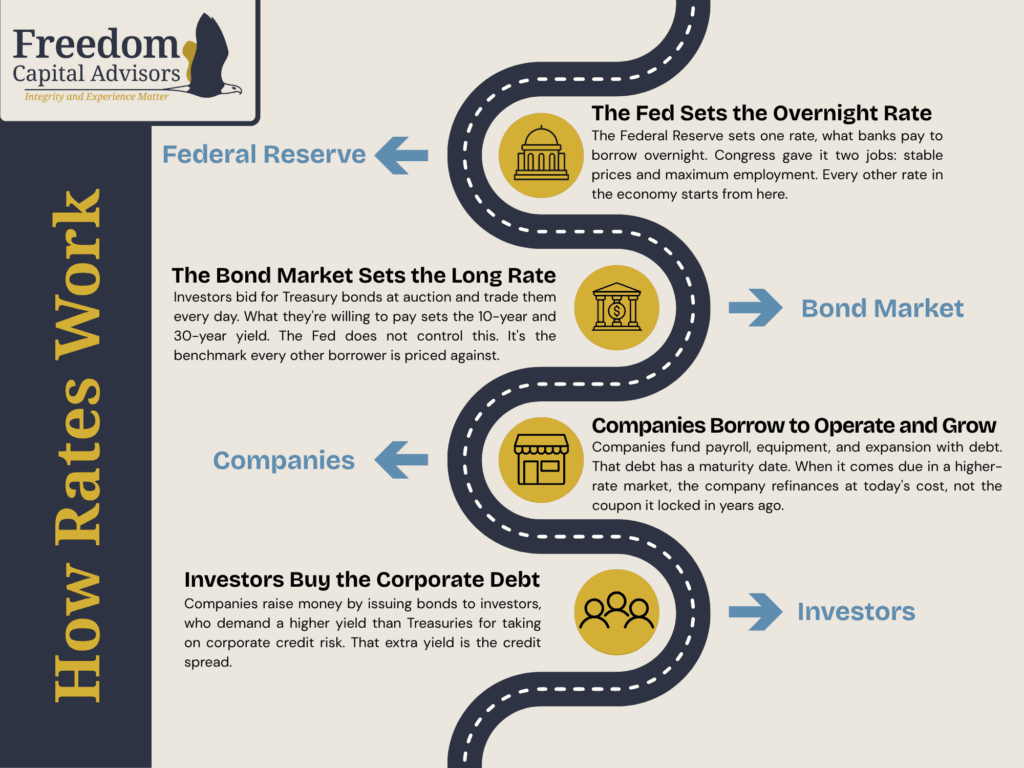
Here is the transmission chain, and it is worth picturing as a line:
The Fed → the banking system → the bond market → companies → investors
The Fed sets the overnight rate. That anchors what banks pay for short-term funding, which flows into lending standards and credit availability. The bond market takes that anchor, adds its own view on inflation and growth over the next decade, and produces the long Treasury yield. Corporate borrowers pay that long Treasury yield plus a credit spread reflecting their own risk. That total is the company’s cost of capital. And the company’s cost of capital determines what it can afford to build, buy, hire, and return to shareholders.
By the time it reaches an investor, a change in long rates has already passed through three intermediaries. It looks like a margin compression, a canceled project, a suspended buyback, or a dividend cut. Most investors experience the symptom without connecting it to the cause.
The Part Most Investors Miss: Debt Comes Due
A company’s interest expense is not fixed forever. It resets on a schedule, and that schedule is public.
Consider the arithmetic. In 2021 the 10-year Treasury averaged 1.39%. Enormous amounts of corporate debt were issued in that window at coupons that reflected it. Those bonds have maturity dates. When one comes due, the company either pays it off in cash or issues a new bond at whatever the market charges that day. As of August 7, 2026, the ICE BofA US Corporate Index yields 5.36% and the BBB tier yields 5.54%.
A business refinancing $500 million of debt from a 3% coupon into a 5.5% market adds roughly $12.5 million a year in interest expense. Nothing about the business changed. No product failed, no customer left. The company simply arrived at a maturity date in a different rate environment. For a company earning $100 million a year, that is a 12% reduction in pre-tax income, permanently, until rates fall or the debt is retired.
This is why we read maturity schedules. Two companies in the same industry with the same margins can be in completely different positions depending on when their debt matures and what coupon it carries. A rising long rate is a minor headline for one and a serious problem for the other.
What Credit Spreads Are Telling Us Right Now
There is a second layer that deserves attention. A corporate borrowing cost has two components: the Treasury rate underneath it and the credit spread on top.
As of August 10, 2026, the option-adjusted spread on the ICE BofA US Corporate Index is 0.78%. That is historically narrow. The bond market is currently charging investment grade borrowers less than 0.8% above Treasuries to take on corporate credit risk.
Read that carefully, because it cuts in a direction most people do not expect. When spreads are this tight, virtually all of a company’s borrowing cost is the Treasury rate underneath it. There is no cushion. If credit conditions deteriorate, spreads have far more room to widen than to compress, and a company facing a maturity in that environment gets hit twice: once by the base rate and once by the spread.
Tight spreads are usually described as a sign of confidence. We read them as a description of how much room there is to be wrong.
What We Do With This
None of this is a market forecast. We do not know where the 10-year goes next, and anyone who tells you they do is guessing with conviction.
What we do is treat long rates as a screening input. When we evaluate a company, we look at the debt maturity schedule alongside the income statement. We ask what the interest expense looks like if the current maturity gets refinanced at today’s market rate rather than the coupon it carries now. We give weight to businesses that fund themselves conservatively, because those companies keep their options open when financing conditions change and their competitors do not.
That fits how we manage money generally. Our covered call income strategies are built to generate income from businesses we are comfortable owning outright. A company with a wall of maturing debt at coupons well below market is not a business we want to own outright, no matter what premium the options market is paying. The rate environment is part of the underwriting, not a separate conversation.
Defense before offense. That principle came out of the bond market, and it still governs how we build portfolios.
Frequently Asked Questions
What is the difference between the Fed funds rate and long-term interest rates?
The federal funds rate is an overnight rate set by the Federal Reserve, governing what banks charge each other for one-night loans. Long-term rates, such as the 10-year and 30-year Treasury yields, are set by supply and demand in the bond market and reflect investor expectations for inflation and growth over many years. The Fed can lower the overnight rate while long-term rates rise, and that has happened since September 2025.
Why do long-term interest rates matter more than the Fed funds rate for stock investors?
Companies borrow at long-term rates, not overnight rates. Corporate bonds, mortgages, and commercial loans are priced off the intermediate and long end of the yield curve. A company’s cost of capital, which determines what it can afford to invest, acquire, or return to shareholders, is driven by long rates plus a credit spread. Changes at the long end reach corporate earnings directly.
How do rising interest rates hurt companies with existing debt?
Existing debt does not reprice until it matures. When a bond comes due, the company must repay it or refinance at current market rates. A business that issued debt at 3% in 2021 and refinances at 5.5% today sees its interest expense on that debt nearly double, with no change in the underlying business. Companies with large near-term maturities carry more of this risk than companies that termed out their debt or carry little of it.
What is a credit spread and why does it matter?
A credit spread is the additional yield a corporate borrower pays above a comparable Treasury to compensate lenders for default risk. As of August 10, 2026, the investment grade corporate spread sits at 0.78%, near the narrow end of its historical range. Narrow spreads mean the base Treasury rate accounts for nearly all of a company’s borrowing cost and leaves little room to absorb a shift in credit conditions.
Where can I see current long-term interest rates?
The Federal Reserve Bank of St. Louis publishes daily Treasury yield data through its FRED database, including the 10-year (series DGS10) and 30-year (series DGS30) constant maturity rates. The U.S. Treasury also publishes a daily yield curve. Both are free and updated each business day. https://www.stlouisfed.org/
Rates cited in this article are as of the dates noted and change daily. This content is educational and general in nature. It is not investment advice and is not a recommendation to buy or sell any security. Investing involves risk, including possible loss of principal.
Freedom Capital Advisors is an independent, fee-only registered investment adviser and a fiduciary. If you would like a second opinion on how your portfolio is positioned for the current rate environment, schedule a strategy session.